Chess rules for beginners
How every chess piece moves, plus check, checkmate, castling, en passant, promotion and draws, explained simply.
Chess looks complicated, but the rules fit on a page. Once you know how each piece moves and what check and checkmate mean, you can play a full game. This guide covers everything, including the special moves that surprise many new players.
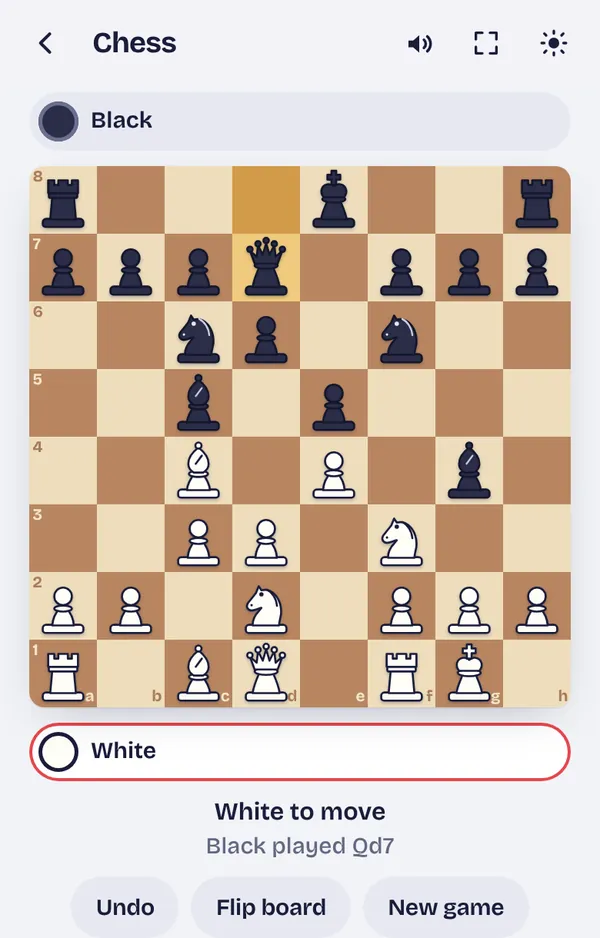
The board and the set-up
The board has 64 squares in 8 rows and 8 columns, alternating light and dark. Place it so each player has a light square in the bottom-right corner. Columns are called files and are named a to h. Rows are called ranks and are numbered 1 to 8, starting from White's side. So every square has a name, like e4.
Each player starts with 16 pieces. The back row holds, from left to right for White: rook, knight, bishop, queen, king, bishop, knight, rook. The queen goes on her own colour, so the white queen starts on a light square and the black queen on a dark one. The eight pawns stand on the row in front. White always moves first, and then the players take turns, one move each.
How the pieces move
- King. One square in any direction. The king is the most important piece, but not a strong attacker.
- Queen. Any number of squares in a straight line, along rows, columns or diagonals. The strongest piece on the board.
- Rook. Any number of squares along a row or a column.
- Bishop. Any number of squares along a diagonal. A bishop stays on the same colour all game.
- Knight. In an L shape: two squares one way and then one square to the side. It is the only piece that can jump over others.
- Pawn. One square straight forward, or two squares on its very first move. It captures differently, one square diagonally forward. Pawns never move backward.
Apart from the knight, no piece can jump. A piece captures by moving onto a square occupied by an enemy piece, which is then removed from the board. You can never capture your own pieces.
Check and checkmate
When a king is attacked, it is in check. The player in check must get out of it straight away, in one of three ways: move the king to a safe square, capture the attacking piece, or put a piece in between. You are never allowed to make a move that leaves your own king in check.
If a king is in check and there is no way out, that is checkmate, and the game is over. The king is never actually captured. Checkmate is the only way to win apart from the other player giving up.
Before every move, look at all the checks, captures and threats on the board, for you and for your opponent. This habit wins more games than any opening trick.
Castling
Castling is a special move of the king and a rook together. The king moves two squares toward a rook, and that rook jumps over to the square on the king's other side. Castling on the king's side is written O-O, and on the queen's side O-O-O. You may castle only if:
- neither the king nor that rook has moved yet in the game,
- there are no pieces between them,
- the king is not in check, and doesn't pass through or land on a square that is attacked.
On Gamesupa, tap your king and then the square two steps to the side. The rook moves by itself.
En passant
This rule catches many beginners out. If a pawn moves two squares forward from its starting square and lands right beside an enemy pawn, that enemy pawn may capture it as if it had moved only one square. The capturing pawn moves diagonally to the square the other pawn skipped over. This capture is only allowed on the very next move. The French name means "in passing".
Promotion
When a pawn reaches the far side of the board, it must be turned into a queen, rook, bishop or knight of the same colour. Most players choose a queen, but a knight is sometimes better because it can give a check a queen can't. You can have two or more queens at once.
Draws
Not every game has a winner. A game is drawn when:
- Stalemate. The player to move has no legal move but is not in check.
- Threefold repetition. The same position comes up three times with the same player to move.
- Fifty-move rule. Fifty moves by each player pass with no capture and no pawn move.
- Not enough material. Neither side has enough pieces to checkmate, such as king against king, or king and bishop against king.
- Agreement. In over-the-board games, players can simply agree to a draw.
How pieces are valued
To decide whether a trade is good, players use a rough points system: pawn 1, knight 3, bishop 3, rook 5, queen 9. Giving a knight for a rook gains you two points. These numbers are only a guide, because a well-placed piece can be worth more than its value, but they help a lot when you start.
Start playing
The best way to learn is to play. Start on Easy against the computer, use Hint when you're unsure, and take moves back with Undo to see what would have happened. Play chess now, and when you know the moves, read our chess opening tips.