How to win at Tic Tac Toe
The best first moves, how to make a fork, how to stop one, and why perfect play always ends in a draw. Simple Tic Tac Toe strategy for everyone.
Most people play Tic Tac Toe by instinct and are happy to get a draw. But the game has a few simple patterns, and once you know them, you'll rarely lose and you'll win often against anyone who doesn't. This guide explains them step by step.
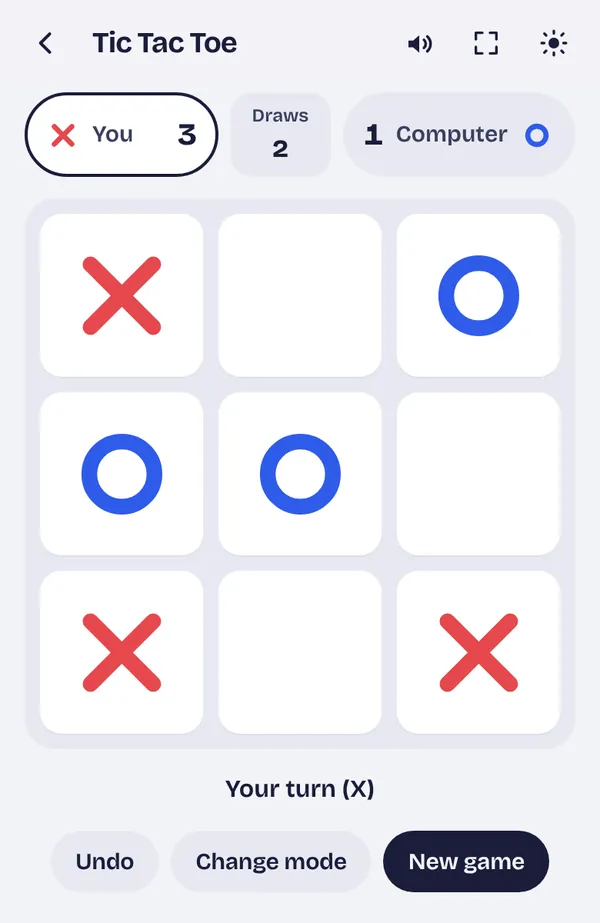
First, the truth about Tic Tac Toe
Tic Tac Toe is a "solved" game. That means every possible game has been worked out, and if both players always make the best move, the game ends in a draw every time. So "how to win" really means two things: never make a losing mistake yourself, and set traps that make it easy for your opponent to make one.
The rule for every move
Before every single move, ask these questions in order:
- Can I win right now? If you have two in a row with the third square empty, take it.
- Must I block? If your opponent has two in a row with the third square empty, take that square.
- Can I make a fork? See below.
- Must I stop a fork? Also below.
Just the first two questions will save you from most losses. Many games are lost because a player is busy with their own plan and misses a simple block.
The fork: how games are won
A fork is a move that makes two lines of two at the same time. Your opponent can block only one of them, so you win with the other on your next turn. Almost every win in Tic Tac Toe between reasonable players comes from a fork.
Forks usually use corners. Corners belong to three lines each (a row, a column and a diagonal), so a mark in a corner creates lots of possibilities. The centre belongs to four lines, which makes it the most powerful square of all.
Playing X (going first)
Start in a corner. It may feel natural to start in the centre, and that's fine, but a corner gives your opponent the most ways to go wrong. If O answers a corner opening with anything other than the centre, X can force a win.
For example, number the squares 1 to 9 from top left to bottom right. X plays 1 (top left). If O plays an edge square such as 2, X can play 5 (centre), threatening 9. O must block on 9, and X then plays 4 or 7 to make a fork. O can only stop one line.
If O answers correctly in the centre, keep playing safely: take the opposite corner and look for chances, but expect a draw.
Playing O (going second)
As O, your first job is not to lose. The rules are short:
- If X starts in a corner, take the centre. Any other reply can be beaten.
- If X starts in the centre, take a corner. An edge square here gives X a winning attack.
- If X starts on an edge, take the centre or a corner next to X's mark.
Watch out for one famous trap. If X has two opposite corners and you have the centre, don't play a corner on your next move. That gives X a fork. Play an edge square instead, which forces X to block you and breaks the attack.
Against the computer on Gamesupa
- Easy often misses blocks. Practise making forks and you'll win most games.
- Medium blocks most of the time. Corner openings and quick forks still work.
- Hard looks at every possible move and very rarely slips. Aim for a draw, and pounce if it leaves a fork open.
Use Undo to replay a loss and find the moment things went wrong. It's usually a missed block or a fork you didn't see coming.
Variations to try with friends
When regular Tic Tac Toe always ends in a draw, try a twist. In Misère Tic Tac Toe, the player who makes three in a row loses. In Ultimate Tic Tac Toe, each square of a big board contains a small board, and where you play on the small board decides where your opponent must play next. Both are easy to play on paper.
Remember the order: win, block, fork, stop the fork. Say it in your head before every move and you'll be very hard to beat.