2048 rules explained
How 2048 works: the grid, sliding and merging tiles, where new tiles appear, how scoring works, and when you win or lose.
2048 takes a few seconds to learn and a long time to master. There are no hidden rules and no luck in how tiles move, only in where new tiles appear. This guide explains every rule, so you know exactly what happens on each swipe.
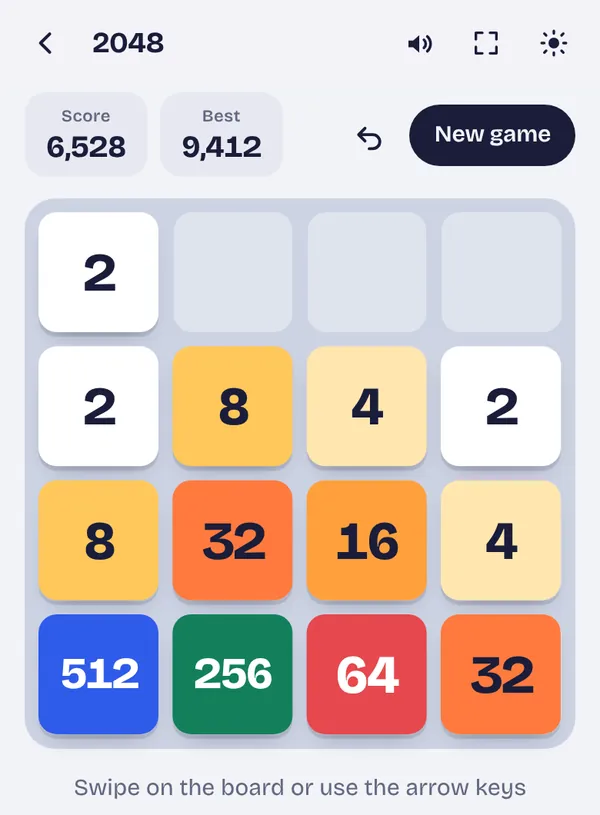
The board
The game is played on a grid of 4 rows and 4 columns, 16 squares in all. At the start, two tiles appear in random squares. Each tile is a 2 or a 4. Everything else is empty.
Making a move
A move is one swipe in one of four directions: up, down, left or right. On a computer you use the arrow keys instead, or W, A, S and D. Every tile on the board slides in that direction as far as it can go, until it reaches the edge or bumps into another tile.
All the tiles move together. You can't move a single tile on its own. This is the most important thing to understand about 2048: every swipe changes the whole board.
If a swipe in some direction wouldn't move or merge any tile, nothing happens and no new tile appears. You simply try another direction.
Merging tiles
When two tiles with the same number slide into each other, they merge into one tile worth their total. Two 2s become a 4. Two 4s become an 8. Two 8s become a 16, and so on, doubling each time:
- 2 + 2 = 4
- 4 + 4 = 8
- 8 + 8 = 16, then 32, 64, 128, 256, 512, 1024 and 2048
Tiles with different numbers never merge. A 4 next to an 8 just sits beside it.
The small print of merging
A few details decide what happens when three or four equal tiles are in a row:
- Each tile merges once per move. A new tile made in this move can't merge again until your next swipe. So a row of 2, 2, 4 swiped left becomes 4, 4, not 8.
- The front tiles merge first. The tiles nearest the edge you're swiping toward are paired first. A row of 2, 2, 2 swiped left becomes 4, 2.
- Four in a row make two. A row of 2, 2, 2, 2 swiped in either direction becomes 4, 4.
Because the front tiles merge first, the direction you swipe changes the result. Swiping 2, 2, 2 left leaves the lone 2 on the right. Swiping it right leaves the lone 2 on the left. Use this to keep small tiles away from your corner.
New tiles
After every move that changes the board, one new tile appears in a random empty square. Nine times out of ten it is a 2, and the rest of the time it is a 4. You can't choose where it lands, so part of the skill is keeping the board in a shape where a new tile won't get in the way.
Scoring
You score points only when tiles merge. Each merge adds the value of the new tile to your score. Merging two 16s into a 32 adds 32 points. Merging two 1024s into a 2048 adds 2,048 points. Sliding without merging scores nothing.
Because every big tile is built from many smaller merges, your score grows quickly as tiles get larger. A game that reaches the 2048 tile usually ends with a score of around 20,000. Your best score is saved on your device and shown at the top of the game.
Winning
You win when you create a tile showing 2048. The game tells you, and you can choose to keep playing. Many players continue to chase 4096, 8192 or an even higher score. The game has no fixed end while moves remain.
When the game ends
The game is over when all 16 squares are full and no two neighbouring tiles, side by side or one above the other, have the same number. At that point no swipe can change the board, so no move is possible. Your final score is whatever you reached.
Undo and saving on Gamesupa
The Gamesupa version of 2048 saves your board and score after every move, so you can close the page and continue later. There is also an undo button to take back your last move, which is a great way to learn: undo a bad swipe, look at the board again, and try to see what you missed.
Ready to play?
Now that you know the rules, the next step is a plan. Read How to win at 2048 for the corner method that most strong players use, or play 2048 now.