Dots and Boxes strategy: how to win more boxes
Safe lines, the third-side rule, chains and the double-cross: simple Dots and Boxes strategy that wins more boxes against friends and the computer.
Most people play Dots and Boxes by drawing lines at random until someone leaves a box open. That works against beginners, but the game has a hidden structure, and once you see it you will win far more often. This guide starts with the one rule every player should know and builds up to the trick that strong players use to win the endgame.
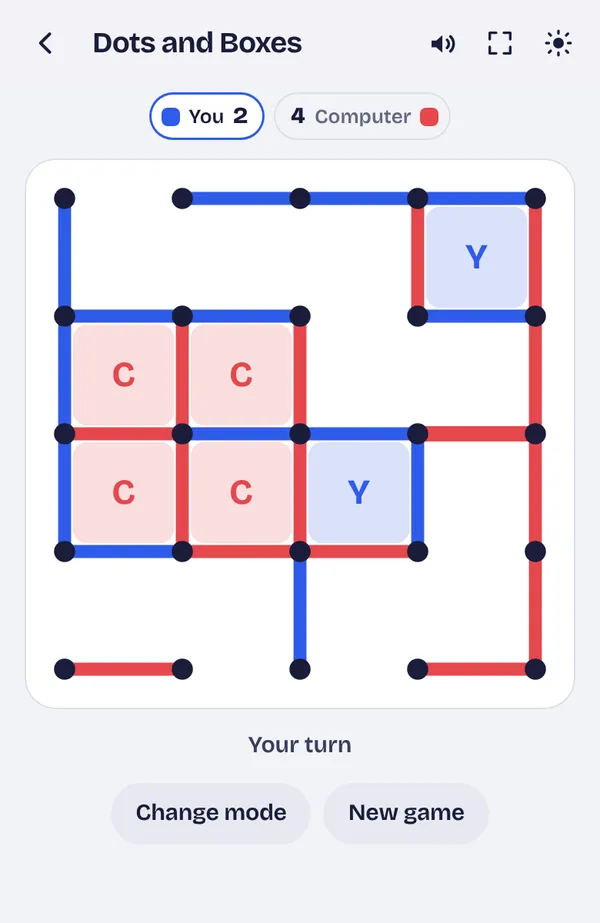
Rule one: never draw the third side
A box belongs to whoever draws its fourth side. If you draw the third side of a box, your opponent simply draws the fourth, takes the box and moves again. So before every line, look at the one or two boxes it touches and count their sides. If either box already has two sides, that line is a gift.
Early in the game almost every line is safe, so both players just avoid third sides. The game is really decided later, when the safe lines run out.
Before you tap, ask two questions: does this line finish a box for me? Does it give a box away? Take the first, avoid the second.
Take free boxes, but think about your extra move
When your opponent leaves a box with three sides, take it. Every box counts, and taking it also gives you another turn. The thing to remember is that after you take your boxes, you still have to draw one more line. If the only lines left are sacrifices, your extra move will hand something back. That is where planning starts to matter.
What chains are
As the board fills up, the open boxes join into chains: rows of boxes where drawing any line inside lets the other player take box after box down the line. A chain of one or two boxes is short. A chain of three or more is long. Some boxes also form loops, which close back on themselves.
Once there are no safe lines left, every move opens a chain. The player who opens it gives the other player all the boxes in it. So the late game is a race: who will be forced to open the long chains?
Give away the smallest chain
When you have to open something, open the shortest chain on the board. Giving away one box is far better than giving away five. This one habit already beats most casual players, and it is how the Medium and Hard computer players on Gamesupa choose their sacrifices.
The double-cross: decline the last two boxes
Here is the trick that separates strong players from everyone else. Suppose your opponent opens a long chain for you. You could take every box in it, but then you must draw another line, and that line opens the next chain for your opponent.
Instead, take all the boxes except the last two. For your extra line, draw the side at the far end of the chain. That leaves the last two boxes as a pair that your opponent can close with a single line down the middle. They take the two boxes, but now they must move again and open the next long chain for you. You gave up two boxes to keep control of the rest of the game.
This move is called the double-cross, and it is only worth it when more long chains are left. If this is the last chain on the board, take everything.
On the last chain, take all of it. On any earlier long chain, think about leaving the final two boxes.
Counting chains, the simple version
Strong players count long chains during the middle of the game, because whoever ends up controlling the endgame usually depends on how many there are. You don't need the full theory to benefit from it. Notice when the board is about to run out of safe lines, count the long chains, and try to make the last safe move yourself so your opponent is the one who has to open a chain first.
Common mistakes
- Drawing third sides in the early game. It feels harmless when only one box is at stake, but it gives away a free move as well as the box.
- Opening a long chain when a short one is available. Always look for the cheapest sacrifice.
- Taking every box without looking ahead. On an early long chain, the double-cross can be worth more than the last two boxes.
- Forgetting that a draw is possible. A 4 × 4 board has 16 boxes, so 8 each is a tie. Every box matters.
Practise on a small board
The 3 × 3 board on Gamesupa has only nine boxes, so you can see the chains form within a minute. Play a few games against the Easy computer, then move up to Medium on 4 × 4. When you start beating Hard on 5 × 5, you are using real chain strategy.
Ready? Play Dots and Boxes now.