Snakes and Ladders rules explained
How to play Snakes and Ladders: the board, starting, moving, ladders, snakes, rolling a 6 and the exact roll to reach 100.
Snakes and Ladders is one of the easiest board games to learn. You can explain it to a child in a minute, and yet a game can still swing from one player to another right up to the last roll. This guide covers the standard rules, the house rules many families add, and how the game works on Gamesupa.
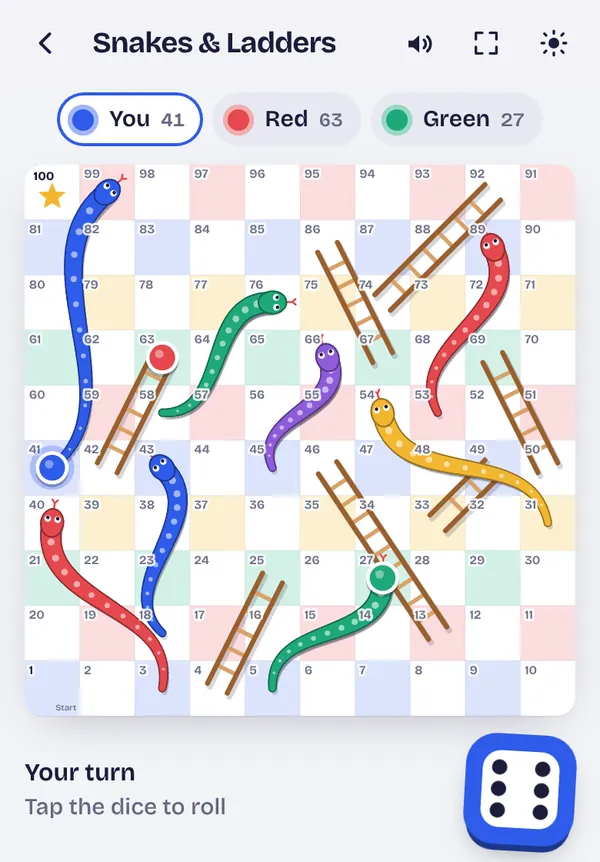
What you need
A board of 100 numbered squares, one die, and one token for each player. Two to four players is usual, though the game works with more on a physical board. On Gamesupa you can play with two, three or four, and any of them can be the computer.
The board
The squares are numbered from 1 in the bottom-left corner to 100 at the top. The numbers zig-zag: the first row runs left to right, the next row runs right to left, and so on up the board. This means your token always moves in one continuous path, turning around at the end of each row.
Ladders and snakes are drawn across the squares. Each ladder links a lower square (its foot) to a higher one (its top). Each snake links a higher square (its head) to a lower one (its tail). Most boards have between six and ten of each.
Starting the game
All tokens begin off the board, just before square 1. Players take turns in order. On your turn you roll the die and move your token forward that many squares. A roll of 4 from the start puts you on square 4.
Some families play that you need a 6 to bring your token onto the board. Until you roll one, you wait. This makes the game longer and gives the start a little extra tension. On Gamesupa you choose "Any roll" or "A 6" on the start screen.
Moving
Count one square for each pip on the die, following the numbers upward. You always move forward, never backward, unless a snake sends you down. There is nothing to choose, because each player has only one token and must move it the full amount.
Ladders
If your move ends exactly on the foot of a ladder, you climb straight to the square at its top. Passing over a ladder on the way doesn't count. Only the square you finish on matters.
A ladder near the bottom can be worth as much as a good roll in the middle of the board, so no early climb is too small to cheer.
Snakes
If your move ends exactly on a snake's head, you slide down to the square at its tail. Again, passing over a snake does nothing. A snake's tail is just a normal square, so landing on it from below is safe.
The biggest snakes usually sit in the top rows. On the Gamesupa board the snake on square 99 drops you all the way to 41, which is why the nineties are the most nervous part of every game.
Rolling a 6
Most people play that a 6 gives you another roll after you move. Some also add a limit: if you roll three 6s in a row, your turn ends at once. Gamesupa uses both rules. The extra roll keeps the game lively, and the limit stops one lucky player from racing up the board in a single turn.
Sharing a square
In the classic game tokens don't affect each other. Two players can stand on the same square, and nobody is knocked back. Some families invent a rule where landing on another player sends them back to the start, but that belongs to Ludo more than to Snakes and Ladders, and Gamesupa leaves it out.
Reaching 100
To win, you need to land exactly on square 100. If your roll is bigger than the number of squares left, there are two common rules:
- Stay put. You don't move this turn and wait for a better roll. This is the rule Gamesupa uses.
- Bounce back. You count up to 100 and then back down with the rest of your roll. Some families like this because it can land you on the snake at 99.
Either way, the first player to land on 100 wins, and the game is over.
A quick example
Riya rolls a 4 and lands on square 4, the foot of a ladder, so she climbs to 25. Her brother rolls a 3, then a 6 that takes him to 9. The 6 gives him another roll, a 4, and he reaches 13, the foot of another ladder that carries him to 46. A few turns later Riya stops on 27, the head of a snake, and slides back to 5. That's Snakes and Ladders: nothing is decided until someone reaches 100.
Why the rules are so simple
Snakes and Ladders is a game of pure chance. Nobody can plan their way to a win, so a young child has exactly the same chance as an adult. That is its strength. It teaches counting, taking turns and handling a bit of bad luck with good grace, which are useful lessons long after the board is put away.
Ready to roll? Play Snakes & Ladders against the computer or with friends on one phone.